The Practical Absurdities of New York State Gun Laws
Author's Opinion
Author's opinion. This page is the author's opinion and satire, with a little Yiddish humor. The facts in it are checked against the statutes, court rulings and official sources listed at the bottom of the page. It is not legal advice.
What is this page? A guided tour of New York's gun laws, the parts that make law-abiding people scratch their heads. The rules are real, and the jokes are ours. The page runs long, because the laws do, so we split it into 5 chapters. Each one opens with a short summary. Tap a chapter below to jump right to it.
New York State has some of the strictest gun laws in the nation, and while proponents argue that these laws are designed to enhance public safety, many of them are impractical, counterintuitive, counterproductive, and outright stupid! Without delving into legal jargon, it is worth examining how these laws fail on a practical level, especially for responsible gun owners and prospective firearm purchasers.
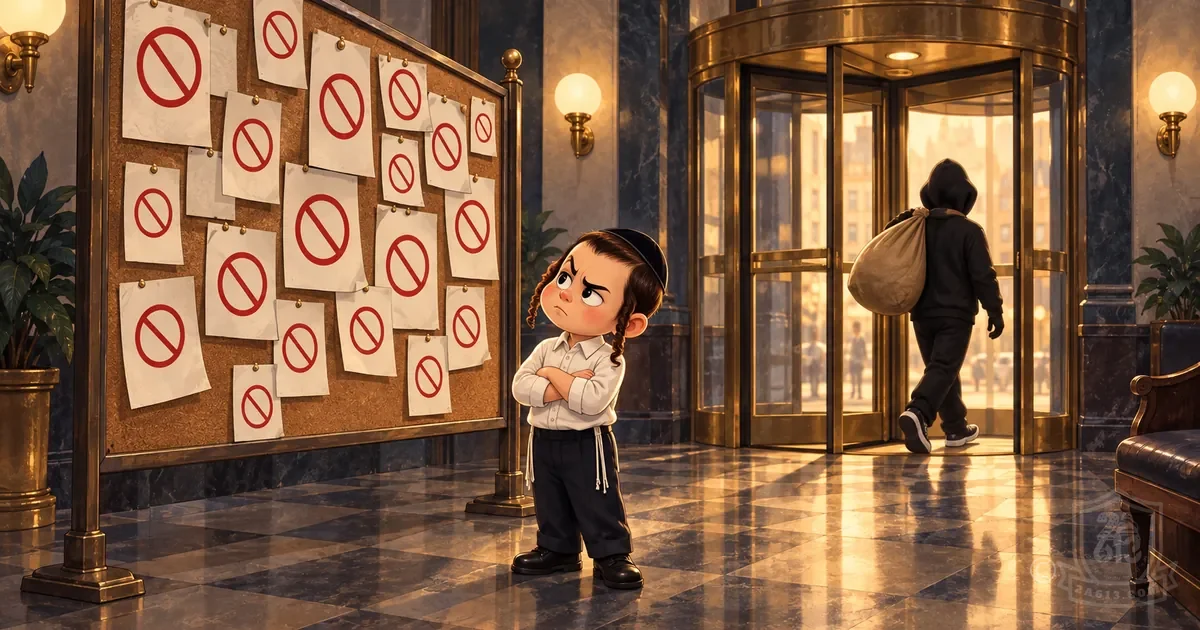
You may not even touch a gun that isn't on your license, so learning is hard. To get a license: four notarized references, your household's details, 18 hours of training, an NYPD interview, and about six months of waiting.
1. The "No Touch" Law: A Barrier to Learning and Informed Decisions
One of the most absurd provisions in New York's gun laws is the restriction that prohibits individuals from handling firearms not listed on their license. This rule makes it illegal for someone to even touch a firearm that they do not already own, presenting a myriad of problems.
Hindering Education: How is a novice supposed to learn how to shoot if they cannot legally handle a firearm? Firearms safety and proficiency are essential skills, yet this law makes it nearly impossible for a beginner to receive hands-on training.
No Testing Before Buying: A prospective firearm owner cannot test various models to find one that fits their needs, hand size, or shooting style. Instead, they are forced to blindly purchase a gun and hope it suits them, a gamble that often results in wasted money or, worse, an unsafe choice.
Rather than encouraging education and informed decision-making, this law fosters ignorance and hinders the development of essential skills.
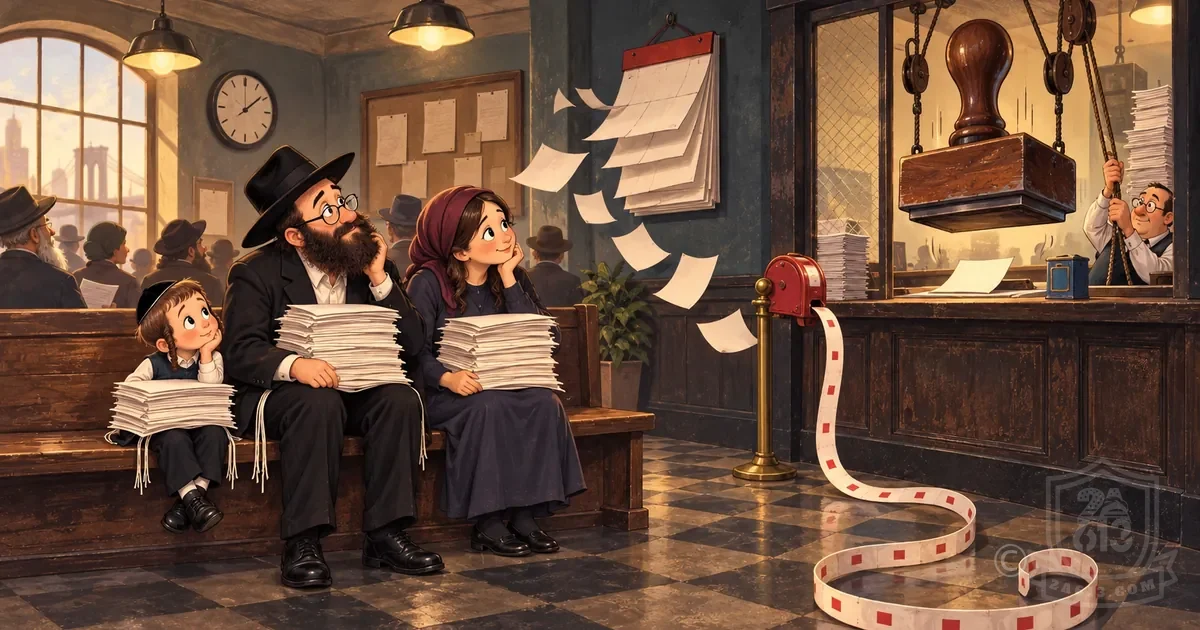
8. The Application: Bring the Whole Family
For an NYC concealed carry license, the law and the NYPD ask for:
Four character references, each signed and notarized, who will vouch that you are of "good moral character." Four people swearing in front of a notary that you're a מענטש. Most שדכנים ask for fewer.
The names and contact information of your spouse and every other adult living in your home, including your adult children, and whether any minors live there. The Second Circuit upheld this part (10/24/2024). If your שוויגער lives with you, her phone number is now part of your gun file.
A list of all your current and former social media accounts from the past three years. This one is blocked by court order: the Second Circuit agreed that making applicants hand over even their anonymous account names goes too far (10/24/2024). In the court's own words, "we grant that Facebook likely would have baffled the Founders." Even the judges noticed.
"Such other information required by the licensing officer" that is "reasonably necessary." An open-ended "and whatever else we think of." Very reassuring.
An in-person interview with the NYPD License Division.
18 hours of training: at least 16 hours in a classroom plus 2 hours of live fire, and you must score at least 80% on a written test. The price is set by the instructor. Sixteen hours in a classroom is a full יום כיפור of דאווענען, with fewer breaks. One of the required topics, of course, is the sensitive places list. You'll need the time.
Fees: $340 to apply (non-refundable, even if you are denied) and $92.00 for fingerprints (raised from $88.25 by an NYPD notice on 10/29/2026; the portal may still show the old fee). Then $340 again every three years to renew, because the license expires every three years. One application, one set of fingerprints and nine renewals is $3,492 in NYPD fees alone, not counting training, notaries and card fees. For a constitutional right. All we can say is אוי וויי.
And a county license doesn't count in the City: a carry license from Rockland, Orange or any other county is not valid in New York City without a separate NYPD permit (the Second Circuit found this likely constitutional in Frey, 09/19/2025). Drive from Monsey to Boro Park and, legally, you crossed a border.
9. The Wait: Six Months, Give or Take a Few ימים טובים
The law says the licensing officer must act on an application within six months, unless they send you a written notice giving a good reason for the delay (Penal Law § 400.00(4-b)). The NYPD itself says you will get a letter "within approximately six months." From our experience at 1 Police Plaza, it is often six months or more.
Six months is enough time to grow a full beard, marry off a child and still have a few weeks left over to קוועטש about the wait. If your application is stuck well past six months, see our NYC guide and our Article 78 Petition for Stalled Applications.
Chapter 2: Licensed, and Still Filling Out Forms
In short
The license is only the start. Every box of ammo means another background check, a vest is off-limits, your car becomes a locker, and the City adds its own permits, magazine limits and even a dress code for gun colors.
3. Ammo Background Checks: Redundant Bureaucracy
Another absurd law in New York requires a background check to purchase ammunition. While the intent may be to prevent criminals from acquiring ammo, the law makes no practical sense for licensed gun owners.
Already Vetted: Anyone purchasing ammunition for a firearm must already have a license for a handgun (in NYC, for any firearm), which means they have already undergone a rigorous background check by the NYPD or another relevant authority. Requiring an additional background check for ammunition is redundant.
Logistical Inefficiency: This process not only delays purchases but also adds unnecessary layers of bureaucracy. For responsible gun owners, it is a pointless inconvenience with no measurable impact on public safety.
This law does nothing to prevent criminals from acquiring ammunition (black markets are readily available), but it imposes a frustrating hurdle on law-abiding citizens.
10. Finally Licensed! Now the Fun Begins
Buying a handgun: you need an NYPD purchase authorization, good for 30 days, and then you report the gun through the NYPD portal within 72 hours of buying it. See our NYC Add Firearm guide.
Buying ammunition: a background check every time, with a $2.50 fee per check. The Second Circuit let it stand (10/15/2025). You were already checked by the FBI, the State and the NYPD. Now check again for a box of 50.
Buying a bulletproof vest: not allowed unless you work in an approved profession. A federal judge held the ban unconstitutional (Heeter v. James, 10/21/2026), but the order is on hold during New York's appeal (11/04/2026), so the ban is still in force. Protect yourself with a gun: six months of paperwork. Protect yourself with a vest: forbidden. So, נו?
"Convertible pistols": starting 05/31/2027, a new law bars dealers from selling them. The State Police list (10/30/2026) covers all Glocks except the V Series, Slimline and Gen6, plus models from 26 other makers. The lawsuit (The Firing Pin, LLC v. James) is pending. The most popular handgun in America, and the dealer can't sell it to you.
Leaving it in the car: it must be unloaded and locked in a safe storage container, out of sight from outside the car (Penal Law § 265.45). Combine that with the list above and your car becomes a locker on wheels. Unload in the parking lot, lock up, שלעפּ to the שמחה, שלעפּ back, reload. Repeat at the doctor, the museum and the wedding hall.
13. More משוגעת
Think that was the whole list? New York has more. Every item below is real, and it is all משוגעת:
A rifle needs its own permit in the City. In most of the State, an ordinary rifle or shotgun needs no license (a semiautomatic rifle is different, see below). In NYC, the NYPD issues a separate Rifle/Shotgun permit: a $140 application fee plus the fingerprint fee, renewed every three years. Already have an NYPD handgun license? You still need the rifle permit, and the NYPD tells you to call the License Division before you even start the second application.
Two permits, two fees, two renewals. One person.
The ammo must match the paperwork. In NYC, a dealer may sell rifle or shotgun ammunition only to someone who shows the permit and the certificate of registration, and only for a shotgun or "the specific caliber of rifle" on that certificate (N.Y.C. Admin. Code § 10-306(c)).
Your brother-in-law's rifle takes a different round? That box stays on the shelf.
Cross the city line, lose half your magazine. Statewide, a magazine may hold up to ten rounds. In NYC, a rifle or shotgun magazine that holds more than five rounds is illegal to own (N.Y.C. Admin. Code § 10-306(b)).
Same rifle, same owner, same background check. Drive from Nassau into Queens and it loses half its capacity.
The seven-round fiasco. The 2013 SAFE Act first limited magazines to seven rounds. As the federal appeals court put it, "very few seven-round magazines are manufactured," so the law was amended: a ten-round magazine was allowed, but outside a range or a competition you could load only seven rounds in it. The Second Circuit struck down that load limit (NYSRPA v. Cuomo, 10/19/2015). The ten-round limit still stands.
First Albany allowed only the magazines that barely exist. Then it allowed the ten-rounder, as long as you left three seats empty. Pure נארישקייט.
A real gun may not be pink. A toy gun must be. In NYC, a toy or imitation gun is illegal unless it is colored white, bright red, bright orange, bright yellow, bright green, bright blue, bright pink or bright purple, or is see-through (N.Y.C. Admin. Code § 10-131(g)). A real gun is illegal if a large part of it is any color other than black, dark grey, dark green, silver, steel or nickel, apart from a wood or ivory-look handle. That's a misdemeanor, with up to a year in jail (§ 10-131(j)).
The City has a dress code for your gun. Pink is for toys only.
Coffee needed the Supreme Court. Until 2019, a City premises license let you take your handgun only to one of seven shooting ranges in the five boroughs. Only one of those ranges was open to the public. A second home or a range outside the City was off limits. When the Supreme Court took the case, the City and the State changed the rules, and the Court declared the case moot (NYSRPA v. City of New York, 04/27/2020). Even then, the new rule said the trip must be "continuous and uninterrupted," and the City's lawyer had to tell the Justices that coffee and restroom stops were OK.
It took the highest court in the land to confirm you may stop for a coffee on the way to the range. And the only fitting reply is אוי געוואלד.
Some licenses expire and some don't. A license issued by NYC, Westchester, Nassau or Suffolk expires every three years and must be renewed. A license from the rest of the State never expires, but you must recertify with the State Police every three years for concealed carry and every five years for a premises license.
Same State, same Penal Law, two calendars. Mark both.
A license for a rifle, too. Since 09/04/2022, you need a Semi-Automatic Rifle License to buy any semiautomatic rifle, and you must be at least 21.
At 18, the State trusts you to vote, sign a lease and enlist. Buying a semiautomatic rifle has to wait.
Chapter 3: Where You Can't Carry (Almost Everywhere)
In short
New York's "sensitive places" list runs to 20 categories, from שול to the subway to the banquet hall. Actors and biathletes get exemptions, private homes need the owner's OK, and every stop means unloading in the parking lot.
4. Sensitive Locations: A Recipe for Risky Handling
New York's requirement to unload and secure a firearm when entering "sensitive locations" creates unnecessary risks.
Visibility to Passersby: Handling a firearm in public, such as in a parking lot, is unsafe and alarming to those who might see and misinterpret the situation.
Increased Risk of Accidents: Each time a firearm is unholstered, unloaded, and secured, there is a chance of accidental discharge. This law forces responsible gun owners to handle their firearms more often than necessary, increasing the likelihood of a mistake.
Practical Inconvenience: Complying with this law disrupts daily routines and creates unnecessary risks, all while providing no real safety benefits.
5. The "Sensitive Places" List: א גאנצע מגילה
On 06/23/2022 the Supreme Court told New York, in Bruen, that law-abiding citizens have a right to carry a handgun in public. Albany said "מזל טוב," and then answered with the Concealed Carry Improvement Act (CCIA). The message: you may carry. Just not... anywhere.
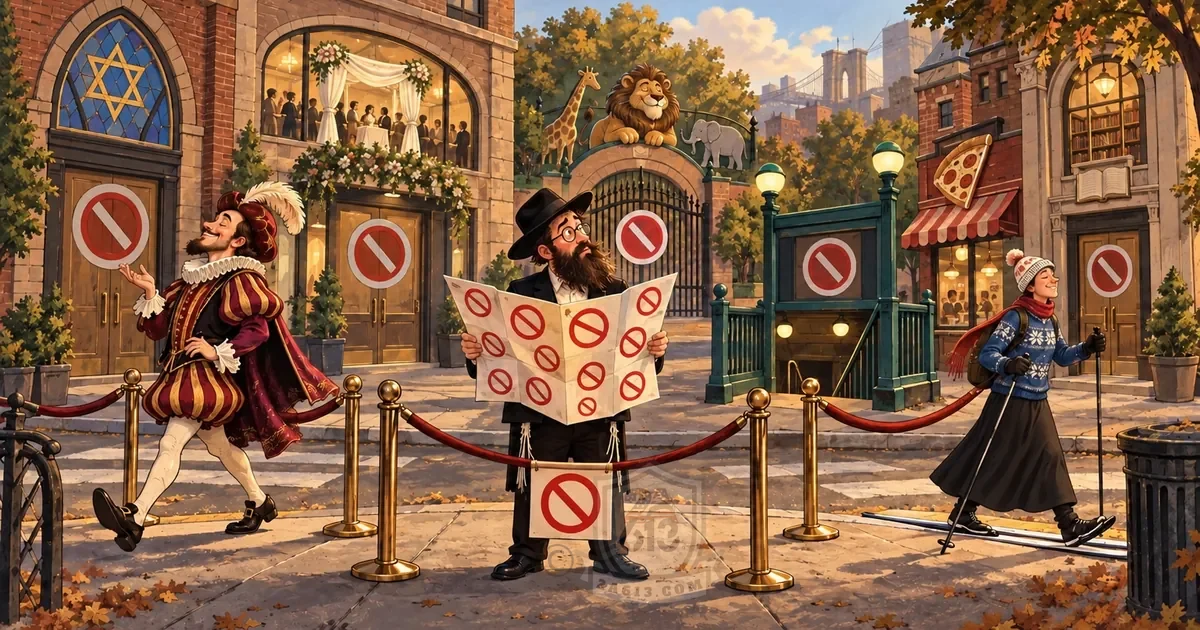
Penal Law § 265.01-e lists the "sensitive locations." The list runs from (a) to (t). That is 20 categories, א גאנצע מגילה, and unlike the real מגילה, nobody hands out משלוח מנות at the end. Here is the list, with our commentary in italics:
Government buildings, including courts.The DMV included. You can wait three hours to renew your registration, but you must do it unarmed.
Any place giving health, behavioral health or chemical dependence care.Feeling faint after reading this list? The doctor's office is off-limits too.
Any place of worship, "except for those persons responsible for security" (added on 05/03/2023, after the lawsuits started). So in שול you need פרוטקציה: a letter from the שול saying you are on the security team. See our sample letter.
Libraries, public playgrounds, public parks and zoos. The Second Circuit upheld the ban in urban parks against a facial challenge (Christian v. James, 05/18/2026), and the challengers have asked the Supreme Court to review it. The lions at the zoo keep their claws. You check yours at the gate.
Nursery schools, preschools, summer camps, and the buildings and grounds of every school, college and university.
The location of any program licensed, regulated, certified or funded by any of five different state agencies (children and family services, developmental disabilities, addiction services, mental health, and temporary and disability assistance). Do you know which agency funds the program on the second floor of the building you are walking into? Neither does anyone else. Guess wrong, and it's a felony.
Homeless shelters, family shelters, domestic violence shelters, and residential settings regulated by the Department of Health.
All public transit: subway cars, train cars, buses, ferries, and every station, terminal and airport. Taxis and Ubers are OK. In Frey v. City of New York the Second Circuit found the subway and Times Square bans likely constitutional (09/19/2025), and the case was later dismissed (07/08/2026). The bans stand. The A train at rush hour is the one place every New Yorker agrees is "sensitive."
Airports are on the same list. On 09/30/2026 the federal court in Antonyuk v. James permanently barred enforcement of the airport ban. The plaintiffs appealed the parts they lost, and the Second Circuit opened the appeal on 11/02/2026. Watch this space. You may still bring your gun unloaded and locked in a hard case to the airline counter to check it, by federal rules.
Any bar or restaurant licensed to serve alcohol on the premises, "where alcohol is consumed."Your favorite כשר steakhouse pours a לחיים at the next table? Off-limits, even if all you ordered was a seltzer.
Theaters, stadiums, racetracks, museums, amusement parks, concerts, exhibits, conference centers and banquet halls.Banquet halls. So the חתונה, the בר מצוה and the ישיבה dinner are all out. So, מזל טוב, leave it in the car.
Polling places.Your civic duty, minus your civic right.
Any public sidewalk closed off for a permitted special event, if it is marked with signs.
"Any gathering of individuals to collectively express their constitutional rights to protest or assemble."Exercise the First Amendment and you lose the Second. A two-for-one deal, except you are the one who pays.
Times Square, as the City draws it on the map, with signs. A separate challenge, Goldberger v. James, is still pending.
Being caught with your gun in any of these places is a class E felony. That's not a parking ticket; that's your license, your guns and your lawyer's next vacation.
6. Who May Carry There? Actors and Biathletes
The same law lists who is exempt. Police officers, retired police officers, armed security guards at work and active-duty military make sense. But read on:
People taking part in "historical reenactments" and "motion picture or theatrical productions."
People "learning, practicing, training for, competing in, or travelling into or within the state" for the sport of biathlon. (That is cross-country skiing with a rifle.)
So an actor in a movie and an Olympic skier get an exemption, but a licensed New Yorker who passed every background check, 18 hours of training and an NYPD interview does not. The חוצפה is almost impressive.
7. Private Property: "Mother, May I?" (Blocked, Mostly)
The CCIA also made it a felony to carry on any private property unless the owner put up a sign saying guns are welcome, or told you yes (Penal Law § 265.01-d). Picture every pizza shop, pharmacy and grocery on Avenue J posting a "Guns Welcome" sign. Exactly.
Blocked for stores and businesses open to the public: the Second Circuit upheld the order blocking it (Antonyuk v. James, 10/24/2024) and did so again in Christian v. James (05/18/2026). The Supreme Court then struck down Hawaii's copy of the same rule in Wolford v. Lopez (06/25/2026).
Still the law for private homes and property not open to the public: you need the owner's express permission. So before you visit your באבע, ask her. Out loud. She'll say, "Since when do you need to ask?" Since 2022, באבע.
Any owner can still say no, by a sign or in person, and you must respect it.
Chapter 4: Gun-Free Zones and the Magic Sign
In short
A "Gun Free Zone" sign disarms only the people who obey signs, and help can be 5 to 10 minutes away. Here is what New York's law actually says about signs, and what the studies do and don't show.
2. Gun-Free Zones: Criminal Havens
Gun-free zones are another glaring example of a law that, in practice, does more harm than good. These zones prohibit the carrying of firearms in designated areas, theoretically making them "safer." In reality, they are criminal havens.
Empowering Criminals: Criminals, by definition, do not follow the law. Knowing that law-abiding citizens are disarmed in these zones, they face no opposition from potential "good guys with a gun." This makes everyone in these areas a sitting duck.
Response Times Are Too Long: It takes an average of 5–10 minutes from the time someone calls 911 for the NYPD to arrive. In an active shooter or violent crime scenario, that delay can mean the difference between life and death. By the time help arrives, it's often too late.
Gun-free zones create a false sense of security while effectively disarming the very people who might be able to stop a threat.
12. The Magic Sign
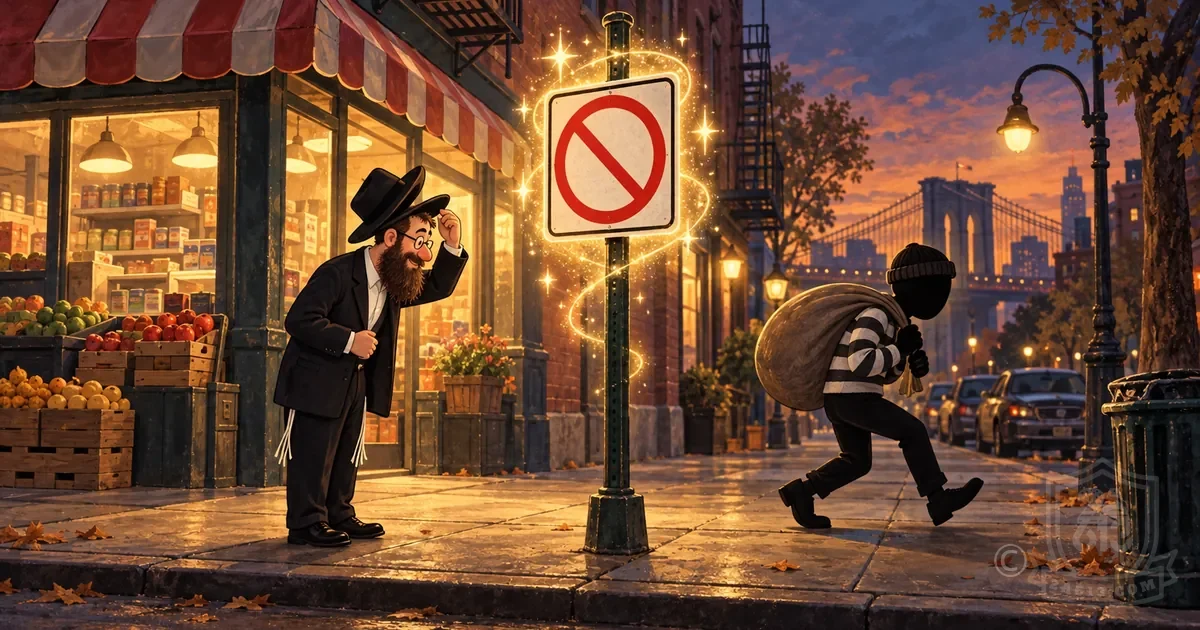
A fair question for Albany: when was the last time a "Gun Free Zone" sign stopped a holdup or a shooting? We looked. We found no agency and no study that counts crimes a sign prevented. A sign is a piece of paper. It works on exactly one kind of person: the one who already obeys the law.
Here is what New York's law actually says about signs:
Sensitive places mostly need no sign at all. Penal Law § 265.01-e makes it a felony to have a gun in a sensitive location when you "know or reasonably should know" it is one. Only two of the 20 categories require a sign: a sidewalk or public area closed off for a permitted event or extra police protection, and Times Square. For the other 18, no sign is required. The State offers a free "Sensitive Location" sign that a property manager may download and post.
So the sign is optional for the building, and the knowledge is mandatory for you. Nobody posts a sign on the second floor saying which state agency funds the program inside.
On private property, it's the other way around. Under Penal Law § 265.01-d, the sign that matters is the "guns allowed" sign. You commit a felony by walking onto private property with a gun unless the owner allowed it by "clear and conspicuous signage" or by "express consent." The State offers a free "Allow Firearms" sign for that, too. For stores and other property open to the public, this rule is blocked (Antonyuk v. James, 2nd Cir., 10/24/2024), and the State Police say they are not enforcing it there. For homes and property not open to the public, it is still the law (see item 7).
In most of America, the sign tells you where you can't carry. In New York, the silence does.
Who reads the sign? The licensed carrier: background checks, fingerprints, four references, 18 hours of training and an interview. He reads it, turns around and goes back to the car. The person planning a robbery or a shooting is already about to commit serious felonies. One more felony, printed on a laminated sheet by the door, is not going to change his plans.
A "No Guns" sign is like a "No גנב" sign on a jewelry store. The only people who obey it are the ones who were never going to steal anything.
What do the numbers say? It depends on who counts, and how. The studies disagree because they count different things:
The Crime Prevention Research Center (CPRC) counts mass public shootings in public places and reports that 92% of them from 1950 through 2024 happened where ordinary citizens were not allowed to carry.
Everytown for Gun Safety counted 156 mass shootings from 2009 to 2016 (four or more killed), including shootings inside private homes. It reported that 10% happened in "gun-free zones" and 63% took place entirely in private homes (04/11/2017).
A UC Davis-led study (The Lancet Regional Health – Americas, 2024) compared 150 places that had an active shooting from 2014 to 2020 with 150 similar places that did not. It found that 48% of the shooting sites were gun-free, against 61.3% of the places without a shooting, and concluded that gun-free zones do not attract shooters.
Pick your study, then pick your definition. Our opinion: whatever the percentage, the sign never once asked the gunman for his license. A sign doesn't stop a bullet. The only thing it reliably stops is the person who might have stopped the gunman.
The belief that a sheet of paper on a door keeps a building safe is a באבע מעשה. In New York, the sign is optional. The felony is not.
Chapter 5: Two Standards, One Revolving Door
In short
For most misdemeanors and nonviolent felonies, the arrested New Yorker goes home without bail, while the licensed one risks a felony for one wrong doorway. And the would-be assassin at a Florida golf course was already barred from guns. An armed agent stopped him, not a law.
11. Two Standards: Arrested vs. Licensed
A tale of two New Yorkers. The first one was arrested. The second one did everything right. Guess which one the law treats as the danger.
New Yorker #1: arrested. New York's bail law was passed in April 2019 as part of the state budget and took effect on 01/01/2020. It ended money bail and pretrial jail for most misdemeanors and nonviolent felonies. For a charge that is not on the bail-eligible list, the law today still says the court "shall release" the person on their own recognizance, or under non-monetary conditions if that alone will not bring them back (Criminal Procedure Law § 510.10(3)). The question the law asks is whether the person will come back to court.
Albany has patched it three times since:
In effect 07/02/2020 (signed 04/03/2020): more charges became bail-eligible, mostly nonviolent felonies, plus the "harm-to-harm" rule: a new case alleging harm to a person or property, while another such case is pending, can carry bail.
In effect 05/09/2022: two rarely charged nonviolent felony gun offenses became bail-eligible, and shoplifting was clarified to count as "harm to property," unless it is "negligible." Even Albany noticed that a shopping bag full of stolen goods is not a gift.
In effect 06/02/2023: judges no longer have to choose the "least restrictive" condition. Now it is the "kind and degree of control or restriction necessary" to bring the person back to court. The researchers who study the law say the new words mean "essentially" the same thing. Three rounds of amendments, and the main question is still the one your dentist's office asks: "Will you make your next appointment?"
Does release lead to more crime? Researchers are still arguing about it. A long-term study by John Jay College's Data Collaborative for Justice (10/2025) followed people for 50 months. In New York City, 57% of people released under the reform were re-arrested in that time, compared with 66% of similar people held on bail before it. Outside the City, the study found no effect either way. But for people with a recent criminal history, and most of all a recent violent felony arrest, re-arrests tended to go up.
In the author's opinion, add plea-downs, dismissals and lenient prosecutors and judges, and for too many of the people who are caught, the result is a slap on the wrist, if the case gets that far.
New Yorker #2: licensed. Four notarized references, 18 hours of training, background checks, an NYPD interview and a wait of six months or more. Then, נעבעך, he walks into the wrong building.
A felony for a doorway. Carrying in any of the 20 "sensitive locations" is a class E felony (Penal Law § 265.01-e), which can carry up to four years in prison (Penal Law § 70.00).
"Knows or reasonably should know." The crime covers a carrier who "knows or reasonably should know" that the place is a sensitive location. Not only someone who knew. Someone who should have known. Should have known that the program on the second floor is funded by one of five state agencies. Should have known where the park ends. Should have known what the State knows, without the State telling you.
The rest of your life. Federal law bars anyone convicted of a crime punishable by more than one year in prison from possessing a firearm (18 U.S.C. § 922(g)(1)). A class E felony is that kind of crime. The license, the guns and the right itself, gone over one wrong turn.
So there are two standards. For the person who was arrested, the law asks, "Will you come back to court?" For the person who did everything right, the law asks, "Should you have known?" One question is about a calendar. The other is about a felony. The only word for it: אוי, א געוואלד.
14. Laws Only Stop the Law-Abiding
On 09/18/2024, three days after a would-be assassin hid in the tree line of a Florida golf course, the 2A613 Team published an op-ed called "The Reality of Gun Control Failures." Now the record is in, up to date as of 11/08/2026:
He was already barred from having any gun. He had several prior felony convictions, including a 2002 North Carolina conviction for possessing a weapon of mass destruction and a 2010 conviction for possessing stolen goods. Under federal law, that alone made every gun and every bullet off-limits to him for life. The law said "no." He said "noted," and kept shopping.
Background check? Skipped. According to federal prosecutors, he bought the rifle, a Chinese-made SKS, for $350 cash in August 2024 at a roofing company's office in Greensboro, North Carolina, through a middleman. The seller and the middleman both later pleaded guilty to federal gun charges. Prosecutors said he planned to remove the serial number so the rifle could not be traced, and when it was recovered, the number was obliterated. Cash, no form, no fingerprints, no four character references, no interview. The black market's application is a lot shorter than the NYPD's.
The laws didn't stop him. An agent did. On 09/15/2024 a Secret Service special agent, patrolling one hole ahead of then-candidate Donald J. Trump, saw a rifle barrel poking through the fence line, pointed his way. The agent fired. The gunman dropped the rifle and fled without firing a shot, and was caught within the hour. The candidate, not yet in view, was roughly 300 to 500 yards away, officials said. No sign, no permit and no waiting period stopped it. A trained, armed good guy did.
The verdict. On 09/23/2025, after a two-week trial in Fort Pierce, Florida, a federal jury convicted him on all five counts: attempted assassination of a major presidential candidate, possessing a firearm in furtherance of a crime of violence, assaulting a federal officer, possession of a firearm and ammunition by a convicted felon, and possession of a firearm with an obliterated serial number. On 02/04/2026 he was sentenced to life in prison plus 84 months. Two of the five counts are classic gun-control laws. They turned into charges only after the agent did his job.
Every one of those laws was on the books the day before. Each one binds the person who obeys laws, and not one of them bound the man who planned to break the biggest law of all. New York's answer is more forms, more fees and more places the law-abiding can't go. That takes real חוצפה. And when someone is caught, the revolving door does the rest (see item 11).
The Bottom Line
Fourteen rules, five chapters, one pattern: every one of these laws lands on the person who follows it, and not on the one who doesn't. That's the whole tour. Here is what it adds up to.
If you feel completely פארבלאנדזשעט by now, that is not your fault. That is the law working as designed.
Laws That Punish the Responsible, Not the Reckless
What is most frustrating about these laws is that they disproportionately impact responsible gun owners. Criminals do not follow laws, whether they prohibit gun possession, ammunition purchases, or carrying in "gun-free zones." These regulations serve only to create obstacles for those who aim to abide by the rules, leaving the general public more vulnerable.
The Need for Practical Reform
New York State's gun laws are riddled with impracticalities that hinder safety, education, and responsible gun ownership. Instead of fostering a culture of informed, safe firearm handling, these laws create confusion, redundancy, and unnecessary risks. Reform is essential, not to diminish public safety but to ensure that the laws in place are practical, enforceable, and aligned with the realities of responsible gun ownership.
Until such reforms are made, New Yorkers will continue to face the absurdities of a system that prioritizes optics over practicality, leaving both gun owners and the public less safe. If you are still wondering how we can make any changes?! Vote like your rights depend on it, because they do.
From the 2A613 Team
We laugh so we don't cry. Every rule in items 5 to 14 is real. We checked each one against the statute, the NYPD or the court ruling listed in the Sources below. The jokes are ours.
Funny is not the same as optional. Follow every one of these rules exactly as written until a court or Albany changes it. A felony charge is no laughing matter. In short: זה לא כדאי.
Disclaimer: All information on this page was gathered from official state websites and other public sources and is provided for general information only. It is not legal advice. Gun laws and reciprocity agreements change often and without notice, and 2a613.com cannot guarantee that this information is complete, accurate or current. 2a613.com, its owners and contributors are not responsible or liable for any mistakes, omissions or outdated information, or for any action taken based on this page. Before you carry in or travel through any state, confirm the current law directly with that state's Attorney General or State Police, and consult a licensed attorney when in doubt. You alone are responsible for knowing and following the laws wherever you are.
To be accepted into our chats: after tapping Join, send us a message through the Contact Us page, choose “Join WhatsApp Groups Request”, then reply to the automatic email with all the requested details.
Join the 2A613 Community
Sign up for occasional newsletters, new guides, and updates from 2A613.
All 2A613 updates are posted only on this Channel: website news, carry law changes for NY, NJ and every state, reciprocity map updates, upcoming events, classes and deals.
Already in our WhatsApp Community? These updates won’t appear in the Community chats. They’re separate, so follow the Channel too.
Don’t want to be busy with group chats? Just want the important updates? This is the channel to follow.